Employee recognition is no longer a secondary consideration; it has evolved into a critical strategic lever that directly influences organizational connection, culture, and ultimately, business performance. Chief Human Resources Officers (CHROs) must grasp this fundamental shift to effectively navigate the modern workforce landscape. The current workforce is grappling with a pervasive crisis of disconnection, a phenomenon that manifests rapidly in diminished engagement, increased employee turnover, and compromised business results. Recent data underscores this reality: the 2026 Engagement and Retention Report reveals that employees who feel genuinely appreciated and engaged are a staggering 17 times more likely to feel connected to their colleagues, 41 times more connected to their managers, and an impressive 56 times more connected to company values. This article delves into what CHROs need to understand about contemporary employee recognition in 2026, including methods for assessing current strategies, the hallmarks of effective programs, and the common pitfalls that even well-intentioned initiatives can encounter.
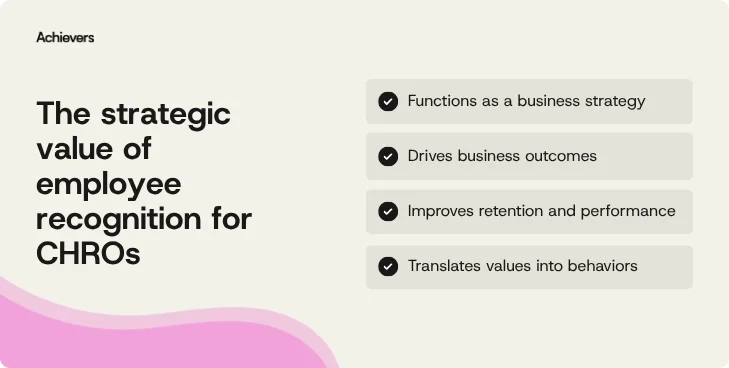
The Strategic Value of Employee Recognition for CHROs
For today’s CHROs, recognition offers undeniable strategic value. When implemented with deliberate intent, it stands as one of the most potent and practical mechanisms for elevating engagement, bolstering retention, and fostering a robust culture at scale. This strategic integration transforms recognition from a mere HR initiative into a core component of how the business operates.
Recognition Functions as a Business Strategy
At its most effective, recognition is not a standalone program that employees opt into; rather, it is intrinsically woven into the fabric of daily operations. For CHROs, it serves as a powerful tool to guide employee behavior, reinforce strategic priorities, and articulate expectations with clarity, all without introducing additional bureaucratic layers. When recognition is viewed and managed as a strategic business function, it actively supports, rather than competes with, the broader people agenda of the organization. This strategic alignment ensures that efforts to recognize employees are directly contributing to overarching business objectives.
Recognition Drives Business Outcomes
The impact of recognition is most keenly felt in areas where HR departments often face the greatest pressure: employee engagement, retention, and overall performance. Organizations that consistently prioritize and practice employee recognition tend to experience lower rates of voluntary turnover within reported benchmarks, demonstrably stronger employee engagement levels, and enhanced productivity and performance. Crucially, recognition helps employees understand precisely what constitutes valuable, hard work and encourages its repetition. This direct correlation between recognition and tangible business results solidifies its importance in the CHRO’s strategic toolkit.
Recognition Delivers a Cost-Effective Approach to Retention and Performance
The financial and operational costs associated with replacing disengaged or departing employees are substantial, encompassing recruitment expenses, onboarding time, and the disruption to team dynamics and productivity. Employee recognition acts as a proactive measure, preventing this slide by fostering stronger connections early on. For CHROs tasked with managing budgets while simultaneously meeting stakeholder expectations, recognition represents a rare lever that yields significant impact without demanding constant reinvention or substantial organizational upheaval. Its inherent cost-effectiveness in mitigating turnover and boosting performance makes it an indispensable strategy.
Recognition Translates Organizational Values into Daily Behaviors
Organizational values, while essential, do not inherently shape culture; it is employee behavior that drives cultural evolution. Recognition serves as the crucial bridge, transforming abstract values into concrete actions by publicly acknowledging and celebrating real-world examples of those core values in practice. When employees witness their values being consistently and visibly recognized, they gain a clear understanding of how to embody those principles in their own work, on a daily basis. This translation of values into observable behaviors is fundamental to building a strong, values-driven organizational culture.
What Modern Employee Recognition Means for CHROs in 2026

The landscape of employee recognition has undergone a significant transformation, necessitating a re-evaluation of traditional approaches. Legacy models, forged in a different era of work, often fall short in today’s dynamic and complex organizational environments.
Why Legacy Recognition Models Fall Short
Traditional recognition models were conceived for a workplace vastly different from the one we experience today. They struggle to keep pace with the evolving nature of work, often characterized by hybrid models, distributed teams, and a greater emphasis on agility. These older frameworks tend to be:
- Limited in Reach: They often rely on centralized, top-down initiatives that may not effectively penetrate all levels and departments of an organization, particularly those with frontline or remote workers.
- Reduced in Relevance: The criteria for recognition may be outdated or fail to capture the diverse ways employees contribute, leading to a sense of inequity or exclusion.
- Missing Key Moments: Episodic or annual recognition programs often miss the spontaneous, in-the-moment acknowledgments that are critical for reinforcing desired behaviors and boosting morale.
For CHROs, these limitations restrict the broad applicability and effectiveness of recognition efforts, failing to capture the most impactful moments of employee contribution.
The Shift from Episodic Recognition to Frequent, Embedded Recognition
Modern recognition is characterized by its consistency and its proximity to the actual work being performed. This shift moves away from infrequent, formal awards towards a continuous stream of appreciation. Key attributes of modern recognition include:
- Frequency: Recognition is not a once-a-year event but an ongoing practice, occurring regularly to acknowledge daily efforts and achievements.
- Immediacy: Appreciations are given in a timely manner, directly following the observed behavior or achievement, maximizing its impact and reinforcement.
- Inclusivity: Modern programs are designed to be accessible and relevant to all employees, regardless of their role, location, or work arrangement.
- Peer-Driven: While manager recognition remains vital, modern approaches emphasize peer-to-peer acknowledgments, fostering a culture of shared appreciation and mutual support.
This evolution makes recognition more credible, more inclusive, and far more effective at shaping day-to-day behavior and reinforcing a positive organizational climate.
The Role Recognition Plays in Building Change-Ready, Connected Organizations
In periods marked by constant flux and uncertainty, recognition transcends mere motivation; it serves as a stabilizing force. It provides a sense of continuity and validation amidst change, reinforcing the organization’s core values and the importance of individual contributions.
- Anchoring in Uncertainty: During times of organizational transformation, recognition acts as an anchor, reminding employees of what truly matters and validating their efforts.
- Reinforcing Shared Purpose: Consistent recognition helps align employees around a common purpose, ensuring that despite external shifts, internal focus remains on collective goals.
- Building Resilience: By fostering a sense of belonging and appreciation, recognition builds individual and team resilience, equipping employees to better navigate challenges.
This steadying influence of recognition is the bedrock of a connected company—one where employees feel aligned, engaged, and prepared for future challenges.
How CHROs Can Use Recognition to Drive Engagement, Retention, and Culture
To harness the full potential of employee recognition, CHROs must adopt a systematic and intentional approach, viewing it not merely as an engagement tactic but as a fundamental leadership and culture-building system.
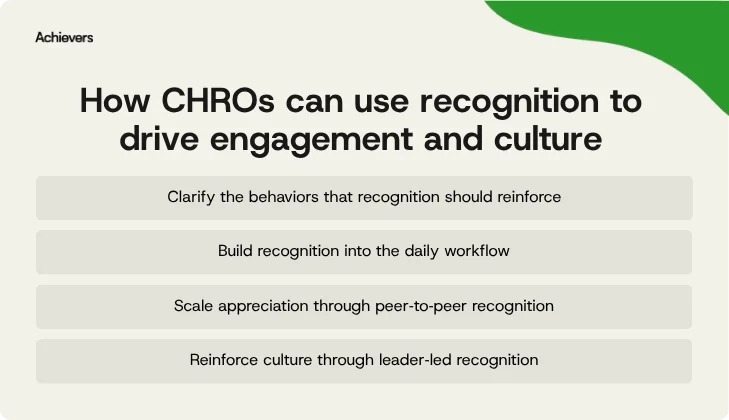
Clarify the Behaviors That Recognition Should Reinforce
Recognition achieves its greatest impact when it is directly linked to clear, defined expectations. CHROs must meticulously identify the specific behaviors that most effectively contribute to enhanced engagement, improved morale, stronger retention, and superior performance. It is imperative that recognition consistently reinforces these targeted behaviors. Vague or generalized recognition dilutes its impact, whereas specific acknowledgments tied to strategic priorities and organizational values provide employees with actionable signals they can readily understand and act upon daily. For example, if innovation is a core value, recognizing employees who propose creative solutions, even if not immediately implemented, reinforces the desired innovative mindset.
Build Recognition into the Daily Workflow
The most potent form of recognition is that which occurs organically within the flow of work, rather than being an appendage to it. Instead of being confined to annual programs or isolated events, recognition should be integrated into the everyday moments where work actually happens. This includes during team check-ins, upon reaching project milestones, celebrating customer successes, and acknowledging everyday collaboration. For instance, a project manager could publicly thank a team member during a daily stand-up for proactively identifying and resolving a potential roadblock, thereby reinforcing problem-solving and initiative.
Scale Appreciation Through Peer-to-Peer Recognition
While manager recognition holds significant weight, it cannot shoulder the entire burden of fostering an appreciative culture. Peer-to-peer recognition dramatically expands visibility, strengthens the sense of belonging, and captures contributions that managers might otherwise overlook. When recognition becomes a shared responsibility, the organizational culture scales organically. CHROs play a pivotal role in establishing the expectation that recognition is a collaborative endeavor—an active offering from employees to one another, rather than a solitary obligation of leadership. Platforms that facilitate easy peer shout-outs, such as internal communication tools, can be instrumental in this regard.
Reinforce Culture Through Leader-Led Recognition
Recognition emanating from senior leaders carries a distinct weight, signaling what truly matters within the organization at that moment. A CEO publicly acknowledging a team’s adept navigation of a challenging change, or an executive commending cross-functional collaboration during a difficult quarter, can clarify priorities more effectively than any formal presentation. CHROs can ensure this impact is sustained by equipping leaders with the tools and encouragement to recognize employees visibly, consistently, and in ways that serve as learning opportunities for others. This could involve leaders sharing specific examples of value-driven behaviors in company-wide town halls or internal newsletters.
Design Recognition That Works Across Roles and Work Models
Effective recognition must reach and resonate with employees regardless of their location or work arrangement—whether they are on the frontline, across different time zones, or working remotely behind a screen. This necessitates designing recognition moments that accommodate diverse realities, ranging from brief peer acknowledgments on the shop floor to digital recognition shared across dispersed teams. When recognition centers on genuine contribution and impact, employees feel seen for the value they bring, not merely for their proximity to leadership or their adherence to a particular work model. This inclusive approach ensures that all contributions are valued and acknowledged.
Positioning Recognition as a System for Shaping Culture
Recognition generates its most profound and lasting value when it evolves into a consistent leadership habit, rather than a one-off initiative. When deployed with regularity, it helps employees understand the organization’s core tenets and their integral role within it. This is the point at which recognition transforms into a robust system—one that CHROs can meticulously track, continuously refine, and leverage to fortify the organizational culture over time. This systemic approach ensures that recognition is not a fleeting program but a perpetual driver of cultural evolution.
How to Measure Recognition ROI—and Fix What’s Not Working
Measuring the return on investment (ROI) of employee recognition begins with a comprehensive understanding of its usage, consistency, and ultimate impact. These metrics provide critical insights into what is proving effective and where adjustments are needed.
What CHROs Should Measure to Prove Business Impact
To demonstrate the tangible business impact of recognition programs, CHROs should focus on a core set of metrics:
- Participation Rates: Tracking the percentage of employees who give and receive recognition indicates the breadth of engagement with the program.
- Frequency of Recognition: Analyzing how often recognition is given, both by managers and peers, highlights the integration of appreciation into daily operations.
- Alignment with Core Values: Measuring the instances of recognition that explicitly reference and reinforce organizational values demonstrates their practical application.
- Sentiment Analysis: Using employee surveys or feedback mechanisms to gauge employee perceptions of recognition and its impact on their engagement and morale.
- Correlation with Performance Metrics: Analyzing how recognition data correlates with key performance indicators (KPIs) such as employee retention rates, productivity levels, and customer satisfaction scores.
How to Link Recognition Data to People and Business Outcomes
Connecting recognition data to broader organizational outcomes requires a strategic analytical approach:
- Retention Analysis: Compare turnover rates among highly recognized employees versus those who receive little to no recognition.
- Engagement Surveys: Correlate recognition program participation and sentiment with scores on employee engagement surveys, looking for trends in areas like connection, motivation, and job satisfaction.
- Productivity and Performance Data: Examine if teams or departments with higher recognition engagement show improved productivity metrics or achieve business goals more consistently.
- Culture Surveys: Assess if consistent recognition efforts correlate with positive shifts in perceived organizational culture, such as improved trust, collaboration, and psychological safety.
Common Recognition Challenges CHROs Face—and How to Overcome Them
CHROs often encounter several hurdles in implementing and sustaining effective recognition programs:
- Lack of Manager Buy-In: Managers may perceive recognition as an additional burden. Solution: Provide clear training on the strategic benefits and practical implementation of recognition, integrating it into performance management discussions.
- Inconsistent Application: Recognition may be sporadic or favor certain individuals or teams. Solution: Establish clear guidelines and expectations for recognition, leveraging technology to ensure equitable distribution and track usage.
- Irrelevance of Rewards: Rewards may not align with employee preferences or perceived value. Solution: Offer a diverse range of recognition options, from monetary bonuses and gift cards to experiential rewards and public acknowledgments, and survey employees on their preferences.
- Perception of Favoritism: Recognition may be seen as subjective or biased. Solution: Emphasize data-driven recognition and peer-to-peer systems, ensuring transparency in award criteria and selection processes.
- Failure to Link to Business Goals: Recognition may be seen as a standalone activity. Solution: Explicitly connect recognition criteria to strategic objectives and desired behaviors that drive business outcomes, communicating these links clearly to employees.
How Recognition Turns into Results: What CHROs Should Do Next
The critical question for CHROs is not whether recognition matters—it unequivocally does—but rather whether it is effectively implemented in the moments that hold the most significance. In times of employee disconnection, uncertainty, or strain, recognition often serves as the primary signal indicating whether their work continues to be valued. When executed proficiently, it becomes the vital thread that connects individuals to their purpose, to their colleagues, and to the core values of the organization.
The CHROs who are excelling in this domain are not merely pursuing superficial programs or isolated victories. Instead, they are diligently observing where recognition manifests, who it reaches, and how it reinforces the specific type of culture that consistently drives positive results. Furthermore, they are committed to honestly evaluating what is functioning effectively and what requires evolution.
If this strategic approach to recognition aligns with your organizational aspirations, resources such as those provided by Achievers can illuminate the transformative possibilities that well-executed recognition strategies can unlock. The journey towards a more connected, engaged, and high-performing workforce is paved with intentional and impactful appreciation.