The landscape of talent acquisition has undergone a profound transformation, with recruiting teams now contending with an unprecedented surge in applications, increasingly compressed timelines, and elevated expectations from both candidates and hiring managers. A single mid-level position can readily attract hundreds of applicants within days, rendering the traditional, manual processes of reviewing every resume and scheduling each preliminary phone screen utterly unsustainable. This escalating volume has necessitated a paradigm shift, propelling artificial intelligence (AI) recruiting tools from niche solutions to indispensable components of effective talent strategies. These sophisticated software platforms are designed to automate or significantly assist with the most volume-intensive and repetitive aspects of hiring, thereby streamlining operations, enhancing candidate experience, and ultimately, improving hiring outcomes.
The Imperative for AI in Recruitment
The evolution of the global workforce and the digitization of the job search have converged to create a challenging environment for recruiters. Data from various industry reports consistently highlights that recruiters spend a substantial portion of their week – often upwards of 60% – on administrative tasks such as resume screening, scheduling, and routine communication. This leaves insufficient time for strategic activities like direct candidate engagement, relationship building, and deeply understanding departmental hiring needs. According to a 2023 report by Grand View Research, the global human resources technology market, including AI-driven solutions, is projected to grow significantly, underscoring the increasing reliance on technology to manage HR functions. The sheer scale of applications, fueled by online job boards and professional networking sites, means that human recruiters are often overwhelmed, leading to slower response times, potential overlooked talent, and a degraded candidate experience. AI tools directly address these pain points by intelligently sorting candidates, identifying optimal fits, facilitating timely communications, and maintaining process momentum without requiring constant human intervention at every step.
Defining AI Recruiting Tools
At their core, AI recruiting tools are software platforms that leverage artificial intelligence, including machine learning (ML), natural language processing (NLP), and predictive analytics, to automate or augment specific phases of the hiring lifecycle. This can range from autonomously searching extensive databases for passive candidates to objectively scoring resumes against predefined job descriptions, automating interview scheduling, or even managing a comprehensive hiring workflow from initial job posting to the presentation of an interview-ready shortlist. The distinguishing characteristic of these tools lies in their capacity for "automation with judgment." Unlike simple automation that merely shuffles data, AI-powered systems can make recommendations, discern complex patterns within vast datasets, and execute actions on behalf of the recruiter, all while operating within pre-established guardrails and parameters set by human oversight.
A Brief Chronology of AI in HR
The integration of AI into human resources is not a sudden phenomenon but rather an evolutionary journey. Early iterations in the 1990s saw the advent of Applicant Tracking Systems (ATS) which, while revolutionary for digitizing applications, were largely database management tools. The early 2000s brought keyword search capabilities, allowing recruiters to filter resumes based on explicit terms, a rudimentary form of automated screening. The 2010s marked a significant leap with the rise of machine learning, enabling systems to learn from historical hiring data, identify patterns, and offer more sophisticated matching and prediction capabilities. This era saw the emergence of tools that could analyze behavioral data, sentiment, and even predict job performance. The current decade, particularly from 2020 onwards, has witnessed the explosive growth of generative AI and large language models (LLMs), which have dramatically enhanced capabilities in natural language understanding, content generation (e.g., job descriptions, outreach emails), and conversational AI for candidate engagement, ushering in a new era of intelligent automation.
The Four Pillars of AI Recruiting Tools
Most AI recruiting solutions can be broadly categorized into four distinct types, each designed to tackle specific challenges within the hiring funnel. Understanding these categories is crucial for organizations evaluating potential technology investments.
1. AI Sourcing Tools
These tools are designed to proactively identify and engage potential candidates who may not have actively applied for a role. They achieve this by scouring vast external databases of professional profiles (e.g., LinkedIn, GitHub, industry-specific platforms) or by intelligently mining an organization’s internal existing candidate archive (talent pools, previous applicants). The most advanced AI sourcing tools transcend simplistic keyword matching, allowing recruiters to articulate their ideal candidate profile using natural language descriptions. These systems then return ranked matches based on a holistic assessment of skills, experience, qualifications, and even cultural fit indicators, thereby significantly reducing the time and effort traditionally associated with manual candidate discovery and Boolean search string construction. Industry data suggests that companies leveraging AI sourcing can reduce their time-to-fill by up to 20-30%.
2. AI Screening and Matching Tools
Once applications are received, AI screening and matching tools become invaluable. Their primary function is to review inbound applications and objectively score each candidate against the specific requirements of the role. Some tools focus intensely on resume parsing, extracting structured data from unstructured documents, and then applying complex algorithms to calculate a "match score." Others integrate additional layers of assessment, such as one-way video interviews where candidates respond to pre-recorded prompts, or specialized skills assessments designed to evaluate specific competencies. The overarching objective of these tools is to dramatically reduce the elapsed time between the receipt of an application and the creation of a high-quality shortlist, ensuring that human recruiters can focus their valuable time on evaluating the most promising candidates.
3. AI Interview Platforms
As candidates progress beyond the initial screening, AI interview platforms facilitate structured interviewing processes. These tools deliver standardized recorded prompts to candidates, capture their responses, and then employ AI to transcribe the audio, analyze sentiment, and generate comprehensive summaries or scores. For high-volume roles, these platforms can effectively replace early-stage phone screens, ensuring a consistent and comparable evidence base across all candidates. This standardization helps mitigate unconscious bias that can arise in unstructured human interviews and allows for more objective evaluation criteria. Moreover, the asynchronous nature of these interviews provides flexibility for candidates across different time zones, improving candidate experience and accessibility.
4. All-in-One AI Recruiting Platforms
For organizations seeking a holistic solution to manage their entire hiring process, all-in-one AI recruiting platforms offer a compelling proposition. These comprehensive systems integrate sourcing, screening, assessments, and core applicant tracking functionalities into a single, unified system. This integrated approach eliminates the "stitching problem" – the challenge and inefficiency of managing data and workflows across multiple disparate point solutions. By centralizing all recruiting activities, these platforms provide a seamless experience for recruiters, candidates, and hiring managers, often offering end-to-end analytics and reporting that provide deeper insights into the effectiveness of the hiring process.
Hallmarks of an Effective AI Recruiting Tool
While the market is flooded with AI solutions, not all deliver equal value. The most effective AI recruiting tools share several critical characteristics that distinguish them from less impactful alternatives, ensuring they genuinely enhance the recruitment process rather than introducing new complexities or risks.
- Transparency: A paramount feature is the tool’s ability to articulate why a candidate received a particular score or recommendation. Opaque "black box" algorithms breed distrust among recruiters, pose significant legal risks (especially regarding bias), and hinder continuous improvement. Transparent tools empower recruiters to understand and validate the AI’s judgment.
- Guardrails and Human Control: Automation, especially with AI, must operate within defined boundaries. The best tools are designed to keep humans actively involved at critical decision points, reserving automation for purely mechanical or high-volume tasks. This "human-in-the-loop" approach ensures ethical oversight, allows for nuanced judgment, and prevents uncontrolled automation from creating unforeseen problems.
- Integration Depth: An AI tool, no matter how powerful, becomes a new silo if it cannot seamlessly integrate with existing HR tech infrastructure, particularly the Applicant Tracking System (ATS). Effective tools offer robust APIs and connectors, ensuring that data flows freely and accurately between systems, enriching candidate profiles and avoiding redundant data entry.
- Data Quality and Diversity: The efficacy of any AI system is directly proportional to the quality and diversity of its training data. Tools built on extensive, diverse, and current hiring datasets are inherently more accurate, less prone to bias, and perform better than those trained on small, homogenous, or outdated samples. Vendors should be able to articulate their data sources and bias mitigation strategies.
- Candidate Experience: The ultimate success of a recruiting tool hinges on its impact on the candidate. Tools that introduce friction – slow load times, confusing interfaces, inaccessible formats, or impersonal communication – can deter applicants and damage employer brand. Leading AI tools are designed to make the application and assessment process faster, clearer, and more engaging for candidates, thereby improving application rates and overall perception.
- Ethical Framework and Compliance: Given the sensitive nature of personal data and the potential for bias, top-tier AI recruiting tools adhere to robust ethical guidelines and comply with relevant data privacy regulations (e.g., GDPR, CCPA) and anti-discrimination laws. This includes regular bias audits, explainable AI features, and strong data security protocols.
Industry Spotlight: Workable’s Comprehensive AI Approach
Workable stands as a notable example of an all-in-one recruiting and HR platform that has deeply integrated AI capabilities into its core offerings. With close to a decade of development in AI, Workable leverages an enormous proprietary dataset derived from 260 million candidates and over 2 million hires. This extensive data foundation underpins a suite of AI features that span the entire hiring lifecycle, providing a robust solution for diverse organizational needs.
- Workable Agent: Launched in March 2026, Workable Agent represents a significant leap forward, acting as an AI recruiting agent embedded directly within the Workable ATS. It autonomously manages the top of the hiring funnel, intelligently sourcing passive candidates, conducting preliminary fit checks against job specifications, proactively collecting missing information, and sending personalized outreach communications for each role. This agent continuously scans over 400 million professional profiles to identify strong passive candidate matches before they even consider applying. Customers maintain full control, setting operating guidelines, retaining data ownership, and determining where human judgment is required, ensuring a balanced blend of automation and human oversight.
- AI-Powered Candidate Sourcing: Workable offers AI-generated candidate recommendations, included with all paid plans, drawing from its vast pool of 400 million profiles. These recommendations are intelligently tailored based on the specific job advertisement and are delivered directly within the platform, eliminating the need for separate sourcing tools. The platform also integrates with other critical sourcing ecosystems, including the Indeed Recruiter Extension with Talent Scout, an upgraded LinkedIn Chrome extension for one-click profile export, and Apply with SEEK, further broadening candidate reach.
- Natural Language Search: Workable’s Natural Language Search capability allows recruiters to move beyond complex Boolean strings. Instead, they can use conversational queries, describing their ideal candidate in plain language, to receive ranked results from the extensive candidate database. This intuitive interface significantly speeds up candidate discovery.
- AI Resume Screening and Profile Summaries: To expedite the review process, Workable generates AI candidate profile summaries that include match scores and requirement checklists. Each summary provides a quick, data-driven overview of how a candidate aligns with specific role criteria, enabling recruiters to rapidly assess fit without meticulously reviewing every resume in full. The integrated CV Parser automatically converts resumes into structured, searchable profile data, enhancing data consistency and analysis.
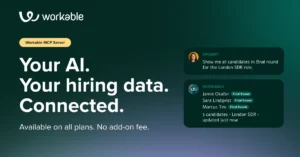
- Workable MCP Server: For organizations utilizing AI assistants or developing their own custom agents, Workable provides an MCP (Model Context Protocol) Server equipped with 94 tools. This server grants AI assistants, such as Claude and ChatGPT, direct read and write access to critical functionalities including candidate and employee search, performance reviews, account and permissions management, and recruiting workflows. This access is managed with the same endpoints and permissions as the human operating the AI, ensuring security and compliance. Every paid Workable account also initiates with 3,000 free AI credits, facilitating immediate exploration and utilization of these advanced features.
Who Stands to Benefit Most from AI Recruiting Tools?
The advantages of AI recruiting tools are multifaceted, extending across various organizational structures and recruitment scenarios.
- High-Volume Recruiting Teams: For teams inundated with hundreds or thousands of applications per role, AI screening and sourcing deliver the clearest and most measurable return on investment. The substantial time savings are evident, and the quality of the candidate shortlist demonstrably improves when human attention is strategically focused on candidates who have already passed a consistent, objective first filter.
- Small HR Teams Operating with Limited Resources: AI tools empower leaner HR teams to manage recruitment processes that would traditionally demand significantly more headcount. Automated sourcing, screening, and candidate communication compress the time from job opening to a qualified shortlist, allowing small teams to achieve disproportionately large hiring outcomes.
- Companies Undergoing Rapid Scaling (e.g., 100 to 1,000 employees): Organizations in phases of rapid growth frequently encounter hiring demands that outpace their existing HR infrastructure. AI recruiting tools provide a scalable layer of support, enabling them to meet aggressive hiring targets without needing a proportional increase in their recruiting function’s headcount.
- Distributed and Remote-First Companies: The asynchronous nature of AI tools is perfectly suited for recruiting across multiple time zones and geographical locations. Candidates can progress through early screening and assessment steps on their own schedule, while recruiters can review results when convenient, fostering a more inclusive and efficient global recruitment process.
Addressing Common Questions and Ethical Considerations
The proliferation of AI in recruitment naturally raises important questions and concerns that warrant careful consideration.
Does AI recruiting software introduce bias?
Yes, it can, especially if developed without rigorous attention to fairness and equity. The primary risk stems from training data that inadvertently encodes historical patterns of human bias present in past hiring decisions. However, well-built tools proactively address this through several mechanisms: employing large, diverse, and balanced training datasets; implementing explainable scoring systems that reveal the rationale behind decisions; conducting regular bias audits; and maintaining human review points at critical junctures. When evaluating a tool, it is crucial to inquire specifically about the vendor’s bias testing methodologies and the control mechanisms in place. Research from organizations like the Equal Employment Opportunity Commission (EEOC) continues to provide guidance on ensuring algorithmic fairness in employment decisions.
Can AI recruiting tools replace recruiters?
No, the consensus among industry experts is that AI tools are designed to augment, not replace, human recruiters. AI excels at handling high volume, ensuring consistency, and performing data-intensive, repetitive tasks. However, AI struggles with nuanced judgment calls that are inherently human: assessing cultural fit, understanding unusual career trajectories, interpreting a candidate’s motivation and aspirations in a live conversation, and building genuine human connections. The fundamental value proposition of AI in recruitment is to offload the mechanical, administrative work, thereby freeing recruiters to dedicate more time to strategic thinking, candidate relationship building, negotiation, and the deeply human aspects of talent acquisition that truly require empathy, intuition, and complex judgment. This shift elevates the recruiter’s role from an administrative gatekeeper to a strategic talent advisor.
How do AI recruiting tools handle candidate data?
Data privacy and security are paramount. Each platform will have its own specific data policy, and organizations must scrutinize these carefully. Key questions to pose include: Who owns the candidate data once it’s submitted? How long is the data retained, and what are the retention policies? Is the data used to train the vendor’s AI models, and if so, how is privacy maintained? Is the data ever shared with third parties, and under what conditions? Thoroughly reviewing the vendor’s data processing agreement (DPA) and ensuring compliance with relevant data protection regulations (e.g., GDPR, CCPA, PIPL) before deployment is non-negotiable.
What is the difference between an AI ATS and a standalone AI sourcing tool?
An AI-powered Applicant Tracking System (ATS) is a comprehensive platform that manages the full spectrum of the hiring workflow. This includes job postings, collecting and managing applications, facilitating candidate communications, scheduling interviews, and managing offer letters. It acts as the central hub for all recruitment activities. In contrast, a standalone AI sourcing tool specializes in the initial phase of finding and identifying candidates, typically operating independently and then "handing off" potential leads or profiles to a separate ATS for the remainder of the process. All-in-one platforms, such as Workable, integrate both sourcing and full ATS functionalities into a single, cohesive system, offering a streamlined, end-to-end solution.
How much do AI recruiting tools cost?
The pricing structure for AI recruiting tools varies significantly based on their scope, scale, and features. Point solutions, which address a very specific part of the hiring process, can start at under $50 per month. Full-platform ATS solutions that incorporate advanced AI features typically range from $200 to $500 per month for small to medium-sized teams, with enterprise-level pricing often negotiated based on employee headcount, number of active job openings, or seat count. Workable, for instance, starts at $299 per month (billed annually) and includes core AI sourcing recommendations, the Workable Agent, and 3,000 AI credits with every paid plan, offering a competitive entry point for comprehensive AI integration.
The Broader Impact and Future Outlook
The adoption of AI in recruitment signifies more than just process automation; it represents a fundamental shift in how organizations attract, evaluate, and hire talent. The implications are far-reaching, influencing labor market dynamics, the skill sets required of recruiters, and the ethical frameworks governing technology use in employment. As AI technologies continue to evolve, particularly with advancements in generative AI and personalized candidate experiences, the future of recruitment will likely feature even more sophisticated predictive analytics, highly personalized career pathing, and truly intelligent assistants that act as trusted co-pilots for recruiters. This evolution promises to make hiring more efficient, equitable, and ultimately, more human, by allowing human professionals to focus on the strategic and empathetic elements that machines cannot replicate. The ongoing challenge will be to ensure that these powerful tools are developed and deployed responsibly, with a steadfast commitment to fairness, transparency, and the enhancement of human potential.