
The global business landscape is abuzz with discussions surrounding reskilling, upskilling, and the accelerated integration of Artificial Intelligence (AI). This sentiment was palpable during recent high-level meetings where Chief Human Resource Officers (CHROs) from India and Singapore converged, with AI readiness and the enhancement of AI fluency across organizations emerging as the paramount concern. The question on everyone’s mind is: "How can we rapidly equip our entire workforce with the capabilities needed to thrive in an AI-driven future?"
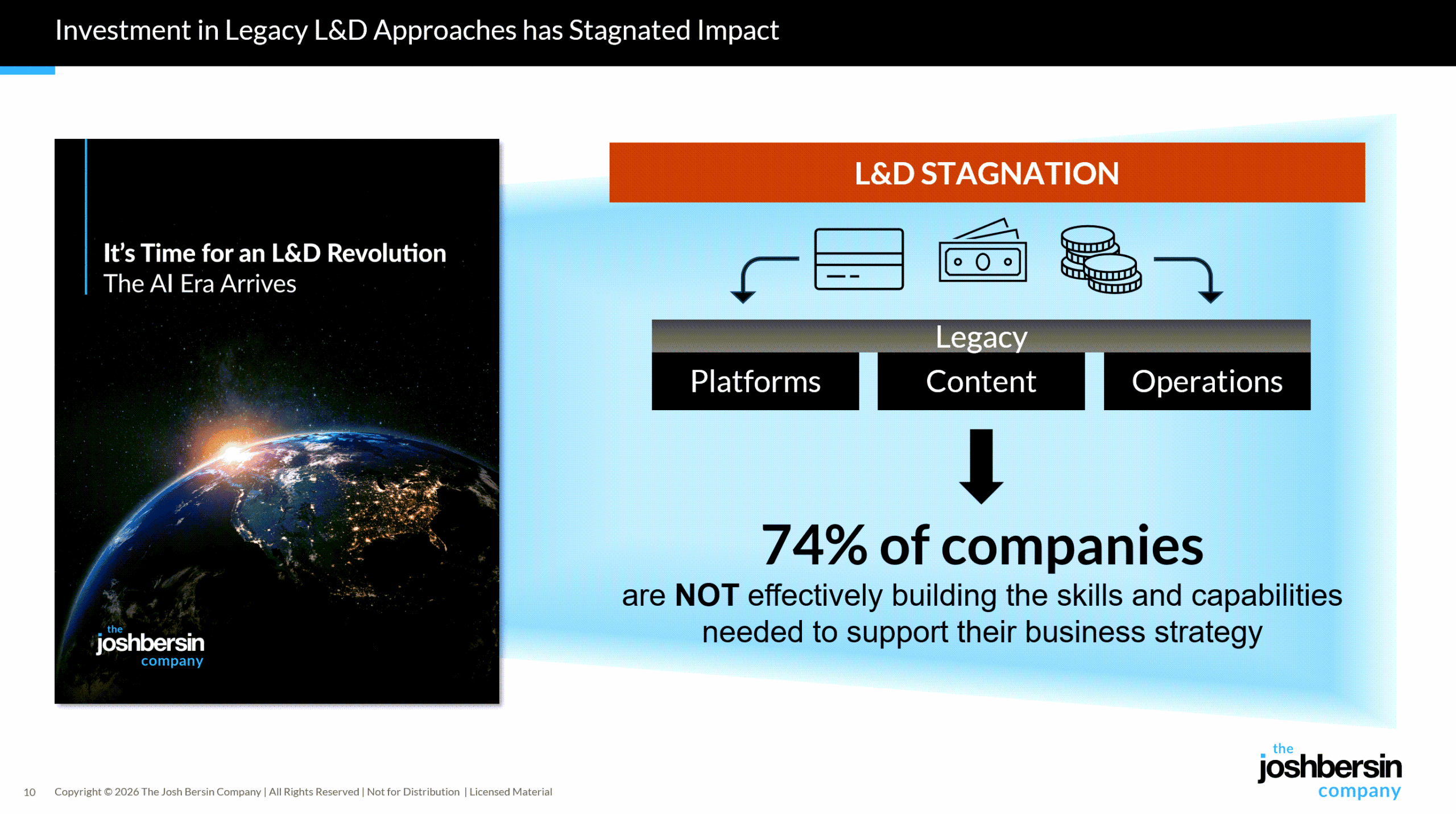
This pressing question underscores a critical realization within the corporate world: the established paradigms of corporate training, encompassing philosophies, technological stacks, and operational models, are demonstrably out of date. A significant new study, the fifth in a series examining corporate Learning and Development (L&D), reveals a stark reality: a staggering 74% of companies admit they are failing to keep pace with their organization’s evolving skill demands. This revelation, from a sector that invests an estimated $400 billion annually in training, content libraries, L&D technology, trainers, and consultants, suggests billions of dollars are being spent inefficiently, with a significant portion of effort yielding insufficient results.
The fundamental challenge, according to this research, lies not in the concept of "learning" or "training" itself, but in a misdefinition of the problem. The true imperative is the dynamic sharing of information, fostering an environment where individuals can explore, question, and apply new ideas. The traditional pedagogical approach, often characterized by rigid "training" modules, appears to be an impediment to progress.

The Genesis of the Study: A Shift in Learning Paradigms
The extensive research, which involved surveying and interviewing hundreds of companies, vendors, and senior leaders, was driven by a core hypothesis articulated in the seminal work, "The Revolution of Corporate Learning." This hypothesis posited that AI possesses the transformative power to fundamentally reinvent organizational learning. As the final findings of this comprehensive study are unveiled, the evidence strongly supports this assertion.
AI-native systems, capable of dynamically generating and sharing content, are poised to revolutionize how organizations train, upskill, support, and ultimately "enable" their employees. This emerging paradigm, exemplified by platforms like Galileo, is set to redefine the very fabric of L&D, HR, and broader organizational change initiatives.
Understanding AI-Native Learning: Beyond Static Content
At its core, AI-native learning leverages generative AI’s capacity for dynamic content creation. Unlike traditional courseware, which is manually designed, built, and updated, AI platforms can generate content on demand, adapting to desired formats and needs. This drastically reduces the time and resources required for content development, transforming months-long processes into mere days. Crucially, when new information or topics emerge, the entire system can be instantaneously updated, ensuring employees always have access to the most current knowledge.
This dynamic approach empowers employees to:

- Discover information organically: Employees can pose questions and receive immediate, relevant answers drawn from the company’s collective knowledge base.
- Learn through exploration: The system facilitates a more intuitive learning journey, allowing individuals to delve into topics as needed.
- Apply knowledge immediately: By providing context-specific information and guidance, AI-native platforms enable employees to apply what they learn in real-time.
Furthermore, these systems automatically categorize content into defined "skills" and infer an employee’s skill level based on their interactions. This creates a seamlessly connected knowledge ecosystem, functioning as a unified "intelligence system" for the organization. The immense success of platforms like ChatGPT, with a significant portion of its vast user base engaging in learning activities, highlights the power of this paradigm. This engagement level far surpasses that typically achieved by traditional course catalogs.
The integration of expert interviews and recordings further enriches these AI-native platforms, ensuring continuous updates with new insights and best practices. This represents a profound application of AI, with the potential to unlock trillions of dollars in business improvements through enhanced workforce capabilities.
A New Framework: The Learning Maturity Model
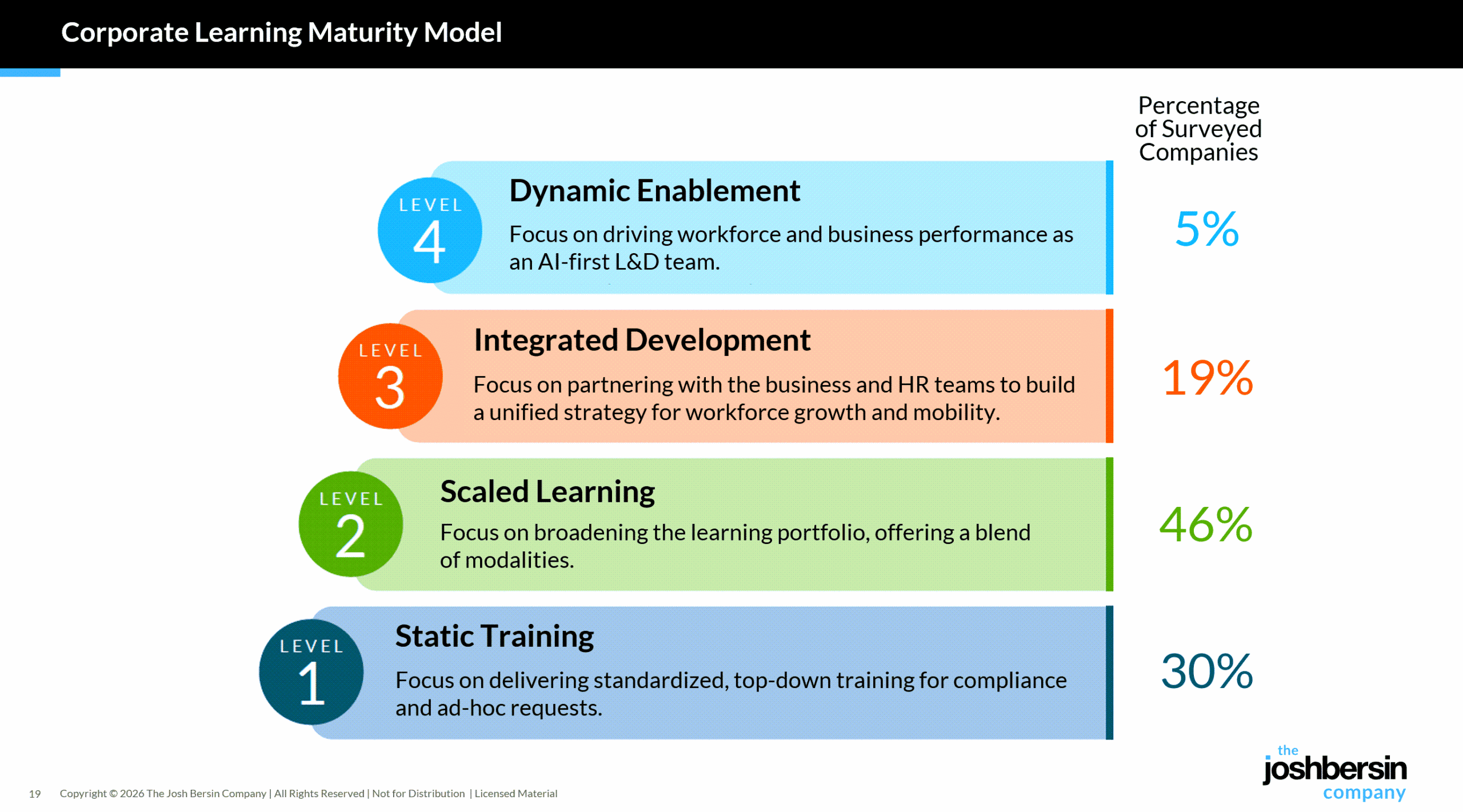
To navigate this evolving landscape, the research introduces a novel Learning Maturity Model, developed over the past year. This model outlines four distinct levels of organizational learning, charting a progression from traditional approaches to AI-driven enablement.
Level 1: Static Training Programs
The foundational stage, characterized by static training programs, primarily focuses on compliance-based or mandatory top-down learning. Companies at this level typically build or procure courses for specific events like product launches or compliance requirements. While cost-effective for initial development, these programs offer limited dynamic skills-based learning and often address episodic needs. This segment accounts for approximately one-third of the market.
Level 2: Scaled Learning
As organizations mature, they move to Level 2, "Scaled Learning," by incorporating a broader array of learning formats. This includes videos, audio recordings, job aids, and other "learning tools." These offerings expand the learning portfolio, often relying on content vendors to provide a diverse range of media and interactive elements. Major online learning platforms like LinkedIn Learning, Coursera, and Skillsoft largely operate within this category. While offering more extensive options, the onus remains on the individual learner to navigate and select appropriate content.
Level 3: Integrated Development
Level 3, "Integrated Development," signifies a shift towards tailoring learning programs around specific job roles, skills, and career paths. Companies at this stage begin to construct comprehensive "development programs" rather than just isolated training modules. This introduces significant complexity, as it requires managing multi-dimensional frameworks encompassing technical skills, professional competencies, job roles, and hierarchical levels.
However, the rapid evolution of skills—with LinkedIn data indicating that approximately 70% of job-related skills become outdated annually—makes maintaining these integrated programs exceptionally challenging. Despite these difficulties, this approach remains valuable for specific applications like channel training, technical education leading to certifications, and onboarding new employees. The cost and resource requirements for L&D departments at this level escalate significantly due to the continuous need for building, maintaining, and refreshing numerous programs, curricula, skills models, and content assets. This complexity often leads to decentralized L&D efforts, with specialized domains like sales, manufacturing, and customer service developing their own training initiatives, creating a "federated" but more intricate training ecosystem.
Level 4: AI Transforms Everything – Dynamic Enablement
The apex of this model is Level 4, where AI fundamentally transforms the learning landscape, ushering in an era of Dynamic Enablement. This stage envisions a platform housing the entirety of an organization’s knowledge, encompassing not only formal courses but also documents, policies, expert interviews, and other informal learning resources.
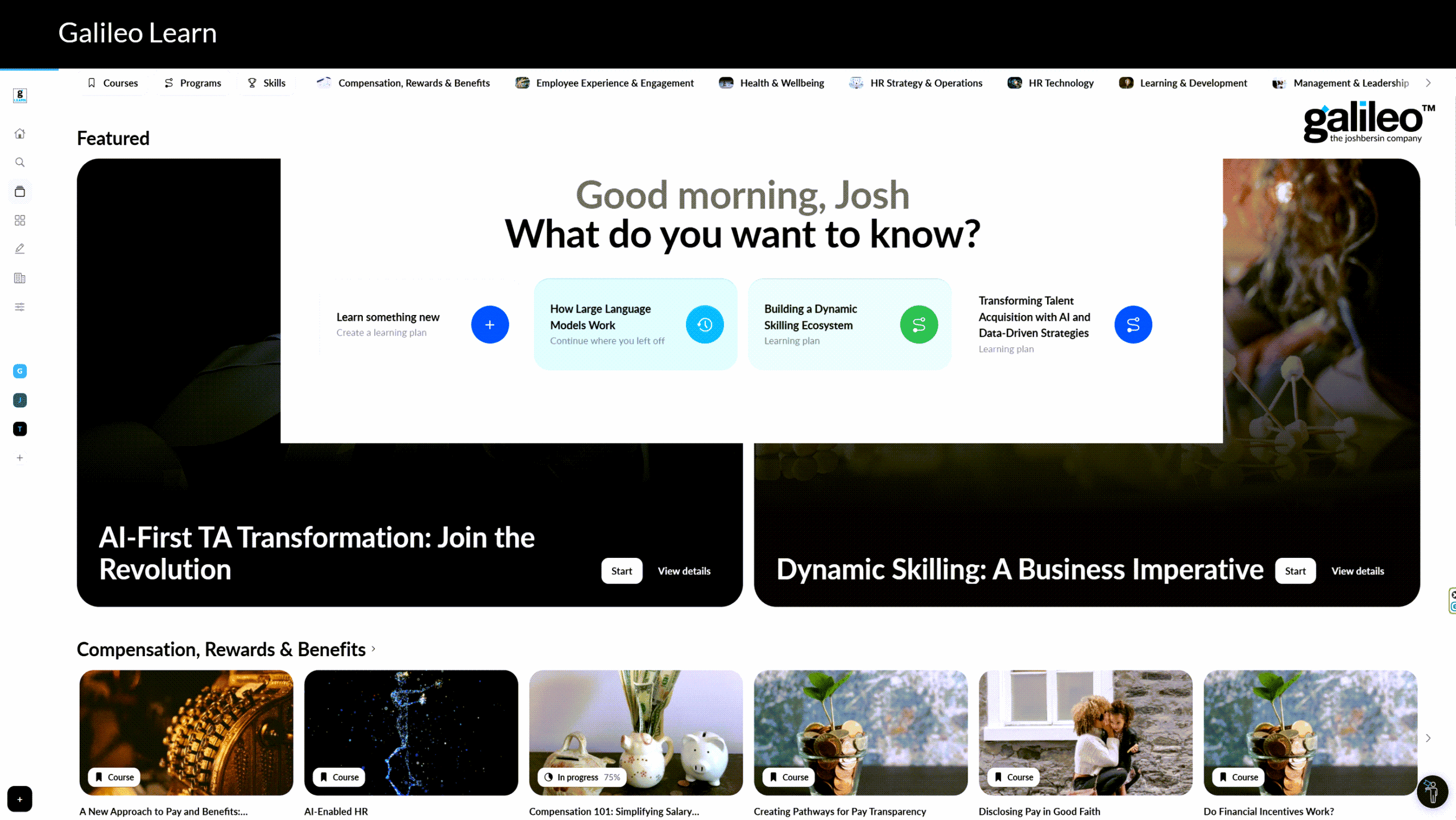
AI-native learning platforms, such as Galileo, facilitate the publication of new information in days rather than months. This empowers every employee to learn in a manner that best suits their individual needs and preferences. While companies may retain traditional Learning Management Systems (LMS) for legacy compliance programs, new AI platforms are increasingly replacing Learning Experience Platforms (LXPs), learning portals, and many traditional content development tools. Early adopters of these AI-native solutions have already reported significant reductions in internal L&D spend, ranging from 40% to 50%.
This transition from formal training to dynamic enablement promises substantial savings in both time and financial resources, while simultaneously delivering an exceptional employee experience. The integration of AI into corporate chatbots and agents further embeds learning into daily workflows. Employees can query benefits information, receive sales coaching for new opportunities, or inquire about departmental updates directly within their existing digital environments.
A compelling example comes from a major travel reservations company that leverages call recordings from top-performing customer service agents. These recordings are integrated into their learning system, allowing other agents to learn from best practices and navigate challenging customer interactions. This capability extends across customer service, engineering, sales, and virtually all support functions.
For instance, a company might publish all new materials, including client interviews, into an AI-native platform like Galileo. This enables any employee to gain insights into a client’s needs, understand industry trends, or prepare for client engagements. This shift from "learning" to "enablement" is crucial, as employees learn not for the sake of learning itself, but to enhance their performance and drive professional growth.
Proven Returns and Future Implications
The research consistently highlights the tangible benefits of Level 4 adoption. Organizations operating at this maturity level demonstrate a significantly higher propensity for innovation, financial success, and adaptability to change. Specifically, Level 4 companies are:
- 10 times more likely to be innovation leaders.
- 6 times more likely to exceed financial targets.
- 16 times more likely to adapt effectively to change.
These outcomes underscore the transformative power of AI-driven learning in fostering agility and strategic execution.
Charting the Path Forward: The Roadmap to Dynamic Enablement
Achieving Dynamic Enablement or AI-native learning is not merely about accelerating course creation. It necessitates a fundamental shift away from traditional SCORM-based LMS platforms towards dynamic content systems. Vendors like Sana, Arist, Disperz, Uplimit, and Colossyan are at the forefront of this technological evolution.
The roadmap to enablement involves several key steps:
- Content Rationalization: Companies must critically assess their existing content, identifying what to retain and what can be transformed. SCORM courses, for example, can often be converted into AI-native formats using platforms like Galileo.
- New Governance Models: Establishing new governance frameworks for L&D is essential to manage the transition and the ongoing evolution of AI-native learning.
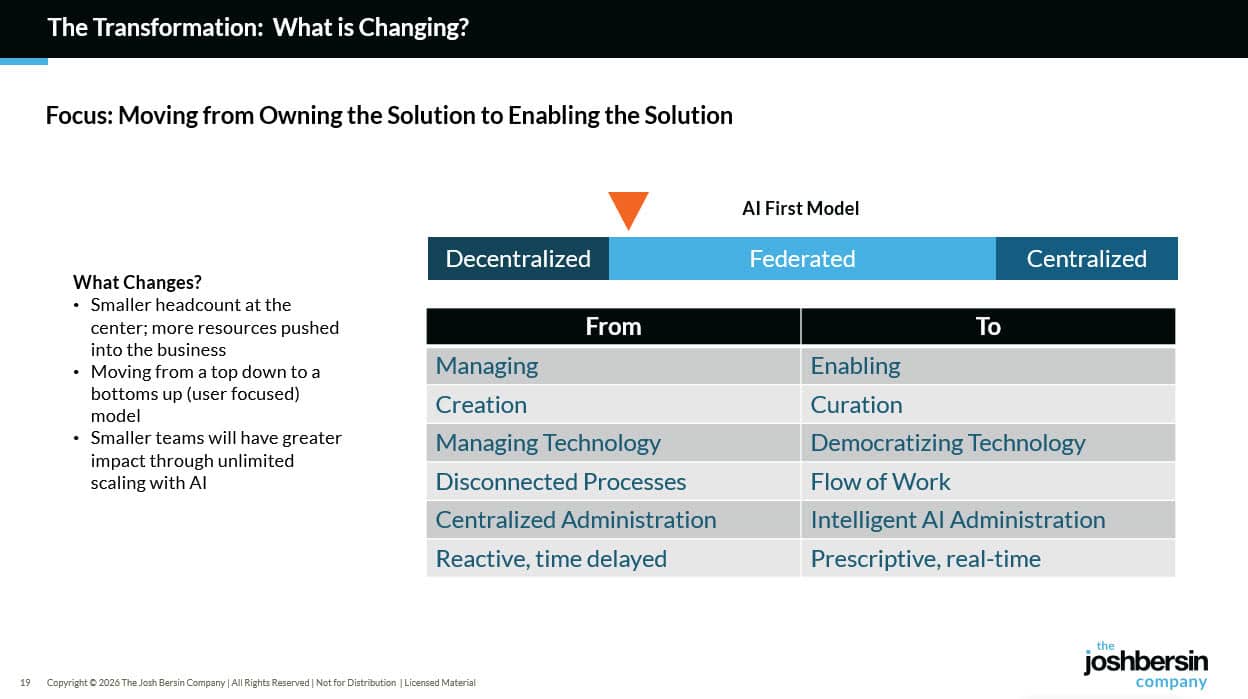
- Hybrid Operating Models: Early adopters are already demonstrating the effectiveness of hybrid or distributed operating models. This allows corporate HR to focus on global strategic initiatives such as leadership development, compliance, culture, and business strategy, while individual business units can establish localized "Enablement Academies" for specific functions like sales or manufacturing.
This federated approach enhances agility, empowering business areas to build and maintain content relevant to their specific needs, fostering a more responsive and effective learning ecosystem.
The Bottom Line: AI-Native Learning as a Business Imperative
The evidence is compelling: AI-native learning is not just an incremental improvement; it is a fundamental shift that will reshape businesses. Organizations that embrace this transformation are positioned to become innovation leaders, achieve superior financial performance, and navigate the complexities of a rapidly changing world with greater resilience. Dynamic enablement represents the future of learning, change management, and strategic execution, equipping organizations with the essential tools to thrive in the AI era.
To facilitate this journey, comprehensive research, case studies, benchmark data, and maturity model diagnostics are available through platforms like Galileo. Furthermore, specialized Agentic Workflows are being developed to assist organizations in diagnosing their maturity level, exploring case studies, and evaluating relevant vendors.
The launch of the "Galileo Learning" program, "The Journey to Dynamic Enablement," offers a structured pathway for organizations seeking to understand and implement AI-native learning. Galileo Suite users can actively author courses, upload content, and directly experience the benefits of AI-native learning firsthand. The invitation is clear: join this transformative journey and redefine the future of your organization’s learning and development capabilities.