Employee motivation is the critical engine that drives performance, especially for mid-market organizations where every resource and every dollar counts. In environments characterized by lean teams and tightly managed budgets, misjudging the levers of motivation can lead to more than just a temporary dip in momentum; it can directly impact results, jeopardize employee retention, and diminish the return on investment. The challenge is compounded by the ephemeral nature of motivation. What inspires employees today might fall flat tomorrow. For leaders in mid-market companies, who are perpetually navigating growth, change, and resource constraints, a decline in engagement is not merely a warning sign but a significant business risk. Recent data underscores this urgency, with Gallup reporting that employee engagement in the U.S. has fallen to a year-low of just 31%, highlighting how quickly momentum can dissipate if organizations fail to adapt. This article delves into practical, scalable motivation strategies specifically designed for mid-market organizations, empowering leaders to achieve impactful results without introducing undue complexity.
What Constitutes Employee Motivation?
At its core, employee motivation represents the dedication, energy, and ingenuity individuals bring to their work daily. For mid-market organizations, this intrinsic drive is a direct determinant of team performance, productivity, and the capacity for adaptation and growth, often achieved without the need for additional headcount. The positive news is that motivation is not an unpredictable force. It can be cultivated through a balanced approach that combines robust support with meaningful recognition. While compensation and career advancement are undoubtedly significant, employees also place substantial value on flexible work arrangements, visible pathways for professional development, and consistent, everyday recognition. These elements are crucial for developing motivation strategies that can scale effectively alongside business expansion. Motivated employees are demonstrably more engaged, more productive, and less prone to seeking opportunities elsewhere. The key takeaway is that fostering motivation is not a matter of chance. By strategically integrating recognition, opportunities for growth, and a focus on well-being, mid-market organizations can cultivate an environment where employees feel genuinely valued, even with lean HR and people operations teams.
Strategies to Cultivate and Sustain Motivation
The following strategies offer actionable frameworks for mid-market leaders aiming to enhance employee motivation and, consequently, business outcomes.
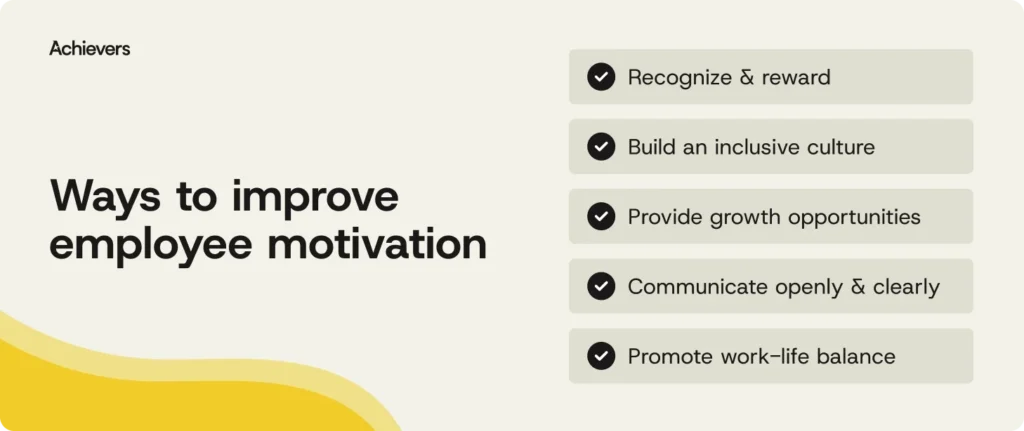
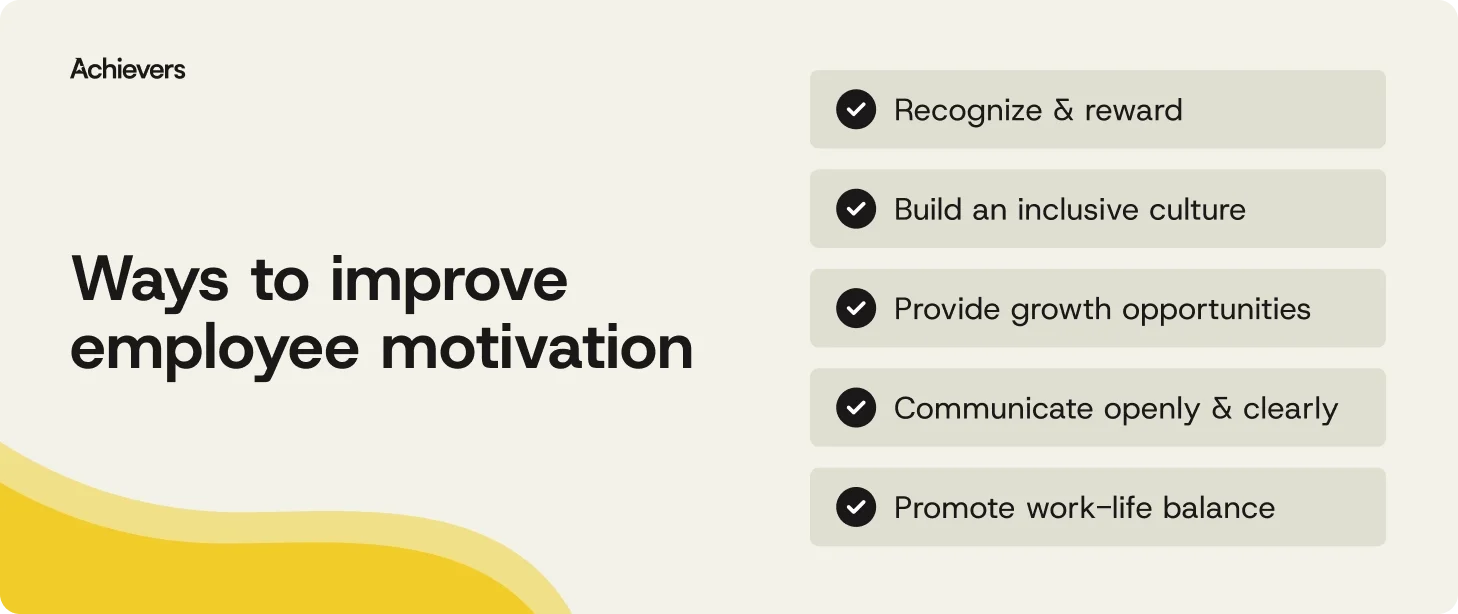
1. Recognize and Reward Consistently and Meaningfully
One of the most potent tools for motivating employees is consistent and meaningful recognition. When individuals feel genuinely appreciated for their contributions, their engagement levels rise, productivity increases, and their commitment to the organization strengthens. For mid-market companies, the most effective recognition programs are those that are easily implemented and frequently utilized, minimizing administrative burdens. This can be achieved through peer-to-peer recognition systems, empowering managers with user-friendly tools, and offering rewards that employees find personally valuable and desirable.
Data from the Achievers Workforce Institute’s (AWI) State of Recognition Report reveals a significant correlation between recognition frequency and employee trust. Employees who receive recognition at least once a month are three times more likely to trust their managers and two and a half times more likely to perceive them as effective leaders. This consistent acknowledgment not only builds trust and reinforces strong performance but also cultivates a work environment where employees are intrinsically driven to perform at their highest level. It is crucial to differentiate between genuine motivation and perfunctory acknowledgments. Recognition that is confined solely to annual performance reviews, for instance, can feel like a mere administrative formality rather than a motivational driver.
2. Cultivate a Positive and Inclusive Company Culture
The influence of company culture on employee motivation is often underestimated by leadership. A workplace founded on principles of trust, respect, and belonging provides employees with compelling reasons to remain engaged and to consistently bring their best efforts to their roles. When employees can clearly see how their individual contributions align with the overarching purpose and mission of the company, intrinsic motivation naturally flourishes.
Recognition plays a pivotal role in reinforcing this positive culture. Public acknowledgments of daily efforts serve to connect individual actions with organizational values, reinforcing the employee’s sense of belonging to something larger than themselves. Peer-to-peer recognition extends this effect, creating a cascading impact that elevates motivation across entire teams. However, a culture that is merely articulated in a mission statement displayed on a wall lacks authentic substance. True culture is lived and experienced daily through the actions and interactions within the organization.
3. Provide Tangible Opportunities for Growth and Development
A powerful motivator for employees is the clear indication that their organization is invested in their professional future, even within the constraints of limited budgets and lean teams. When employees perceive a defined trajectory for skill development and career advancement, their engagement deepens, their motivation intensifies, and their inclination to search for external opportunities diminishes.
Crucially, fostering growth does not always necessitate substantial financial investment. Opportunities such as mentorship programs, participation in cross-functional projects, and short, targeted training initiatives can be as impactful as expensive external courses. The genuine motivator here is the organization’s demonstrable commitment to employee development, rather than merely a superficial mention in an employee handbook.
4. Ensure Open, Clear, and Consistent Communication
Ambiguity in communication is a swift and potent demotivator. Employees require clarity regarding expectations, a clear understanding of how their work contributes to organizational objectives, and consistent feedback on their performance. This clarity fosters confidence, which in turn fuels motivation.

Effective communication transcends infrequent company-wide announcements or quarterly town hall meetings. It encompasses regular one-on-one check-ins, fostering an environment of open dialogue, and establishing channels for two-way feedback. Tools such as pulse surveys and Voice of Employee platforms enable leaders to actively listen, prioritize concerns, and implement changes swiftly, circumventing lengthy approval processes or complex change management protocols. Communication that flows solely from leadership downwards can easily devolve into a monologue, failing to inspire employees to remain invested.
5. Champion Work-Life Balance and Employee Well-being
The detrimental effects of burnout are fundamentally incompatible with sustained employee motivation. Employees who feel perpetually overwhelmed and stretched thin exhibit reduced engagement, lower productivity, and a higher propensity to depart the organization. Implementing flexible work arrangements, offering comprehensive wellness benefits, and providing access to mental health support sends an unequivocal message: the organization prioritizes its people.
Achieving balance does not necessitate radical overhauls of existing policies. Simple measures such as offering flexible scheduling options, ensuring realistic workloads, or providing access to readily available wellness programs can make a significant difference. The overarching objective is to cultivate a work environment where employees can channel their energy into their tasks rather than constantly battling exhaustion.
6. Empower Employees Through Autonomy
Micromanagement is a direct pathway to employee disengagement. When employees are granted ownership of their work, the freedom to make independent decisions, and the trust of their leadership, their motivation levels soar. Autonomy fosters a sense of accountability and provides individuals with the necessary space to perform optimally.
The nuanced aspect of autonomy is that it does not equate to the absence of managerial guidance. Effective coaching, consistent support, and clearly defined parameters ensure that employees feel empowered and confident without feeling abandoned. Managers should function as supportive spotters, present and available when needed, but allowing employees the freedom to execute their tasks.
7. Offer Incentives That Resonate
While standard benefits like health insurance and retirement plans are foundational, they are often perceived as expected rather than inspiring. Employees are more significantly motivated when rewards are perceived as personal and tailored, rather than generic.
This can involve implementing diverse incentive programs, such as wellness stipends, flexible perk options, or personalized rewards that employees can actively utilize and appreciate. The critical factor is aligning incentives with the specific values and preferences of the workforce. Offering rewards that are not genuinely desired or relevant can create noise and detract from true motivational efforts.
8. Actively Address Employee Concerns and Feedback
Employee motivation can rapidly erode when individuals feel their concerns are not being heard. However, passive listening is insufficient; it is the tangible action taken in response to feedback that truly builds trust and sustains motivation.
For mid-market organizations, closing the feedback loop promptly is essential for cultivating trust, which often proves to be the decisive factor in retaining valuable talent versus initiating a new recruitment cycle.
Key Aspects of Employee Motivation
Understanding the underlying drivers of motivation is crucial for developing effective strategies.
Intrinsic Motivation
Intrinsic motivation stems from the inherent satisfaction derived from performing meaningful work. This can manifest as the challenge of solving a complex problem, achieving a personal performance milestone, or contributing to a collective team success. This form of motivation is enduring, often persisting even in the absence of external rewards.
Extrinsic Motivation
Extrinsic motivation is driven by external factors, such as formal recognition, tangible rewards, or financial incentives. A timely expression of gratitude or a points-based reward system can be highly effective. Conversely, neglecting these external motivators can relegate rewards to mere budgetary line items rather than genuine drivers of engagement.
The Interplay Between Motivation and Engagement
The relationship between motivation and engagement is direct and symbiotic. Motivation provides the impetus for action, while engagement reflects the depth of commitment and follow-through. Motivation can be viewed as the initial spark, igniting the drive to perform, while engagement represents the sustained, steady flame that propels work forward.
The Impact of Employee Motivation on Business Outcomes
Employee motivation directly influences the key performance indicators that matter most to mid-market leaders: enhanced performance, accelerated execution, and reduced employee turnover, all achieved without escalating costs. Recognition, as a potent motivational tool, is supported by compelling data. The AWI’s State of Recognition Report indicates that organizations with high recognition rates experience lower voluntary turnover. Furthermore, recognition acts as a vital barometer for workplace health. A decline in recognition often correlates with a dip in engagement and trust, signaling an increased risk of talent attrition.
Organizations like Achievers are instrumental in helping companies transform everyday recognition into measurable business outcomes, providing the scalability of enterprise solutions with the agility required by mid-sized teams. When recognition is integrated into the fabric of daily operations—rather than being an afterthought confined to annual reviews or infrequent celebratory events—motivation ceases to be a fleeting phenomenon. It becomes a sustainable force that scales with the business and drives tangible progress.
Driving Employee Motivation and Success with Achievers
When employees experience genuine motivation, they bring heightened energy, creativity, and a collaborative spirit to their work, creating a positive momentum that propels the entire business forward. Achievers partners with organizations poised for growth but seeking to avoid unnecessary complexity. By embedding recognition into daily workflows, offering rewards that genuinely resonate with employees, and providing real-time analytics, Achievers empowers leaders to cultivate lasting motivation. The ultimate outcome is a workplace culture where employees feel consistently seen, heard, and supported, not just on rare occasions, but every single day.
Employee Motivation FAQs
What is the primary difference between intrinsic and extrinsic motivation?
Intrinsic motivation arises from the personal satisfaction of performing a task, while extrinsic motivation is driven by external rewards or pressures.
How can mid-market organizations implement effective recognition programs on a limited budget?
Focus on peer-to-peer recognition, leverage digital recognition platforms for easy administration, and offer non-monetary rewards such as extra time off, professional development opportunities, or public acknowledgments.
What is the role of leadership in fostering employee motivation?
Leaders set the tone, model desired behaviors, provide clear direction, offer consistent feedback and recognition, and champion a culture of trust and development.
How does employee motivation impact customer satisfaction?
Motivated employees are more engaged and invested in their work, which often translates into better customer service, higher quality products, and a more positive customer experience.
Can technology significantly enhance employee motivation strategies?
Yes, technology platforms can streamline recognition programs, facilitate communication, gather employee feedback, and provide data insights to help leaders understand and respond to motivational needs more effectively.