
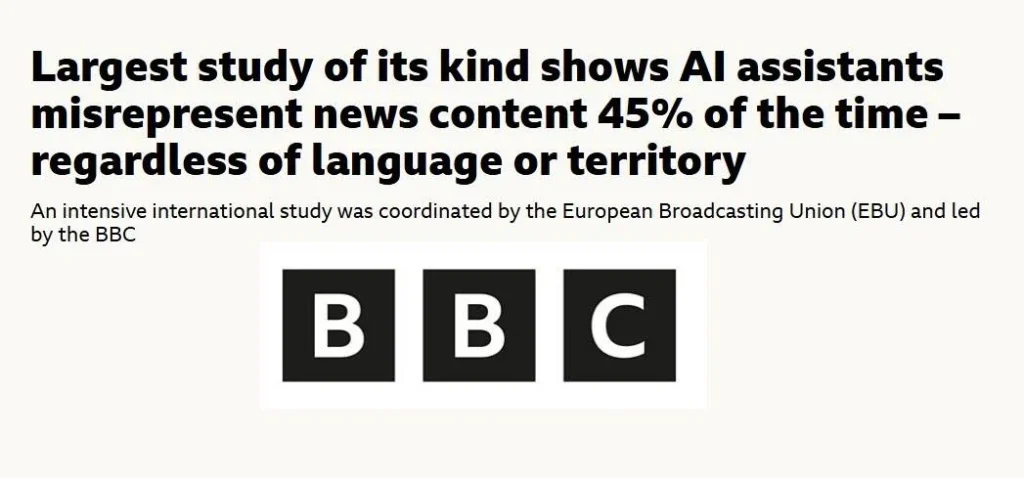
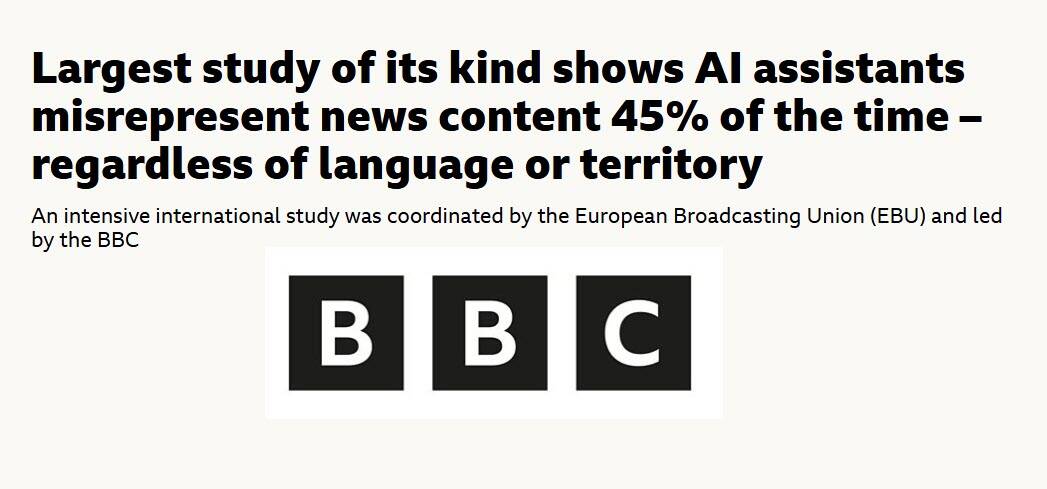
A groundbreaking study, jointly released by the BBC and the European Broadcasting Union (EBU), has sent ripples of concern through the technology and media sectors, revealing a startlingly high rate of inaccuracies in responses from leading artificial intelligence (AI) news assistants. The research, which meticulously examined queries posed to prominent AI models including ChatGPT, Microsoft Copilot, Google Gemini, and Perplexity, found that a significant 45% of these AI-generated news-related answers contained errors. This revelation challenges the burgeoning trust placed in these "open corpus" systems and underscores the critical need for user vigilance and enhanced data integrity within AI development.
The study’s findings, published on October 27, 2025, highlight a stark contrast between the perceived sophistication of AI and its actual performance when tasked with providing reliable news analysis. The EBU, an alliance of public service broadcasters across Europe, and the BBC, a globally recognized news organization, collaborated to conduct this comprehensive assessment, aiming to understand the reliability of AI tools for news consumption and dissemination. Their investigation focused on how these AI models interpret and respond to user queries about current events, factual information, and analytical insights.
A Deep Dive into AI’s Factual Deficiencies
The research uncovered a disturbing pattern of errors, ranging from simple factual mistakes to potentially consequential misinterpretations of legal and medical information. For instance, AI models struggled with basic factual recall, incorrectly identifying prominent figures such as the Pope or the Chancellor of Germany. More alarmingly, when questioned about public health concerns, such as the threat of bird flu, Copilot inaccurately stated that a vaccine trial was underway in Oxford. The source for this misleading information was traced back to a BBC article from 2006, demonstrating the AI’s reliance on outdated and irrelevant data.
The study also pointed to significant legal misrepresentations. Perplexity, for example, asserted that surrogacy is "prohibited by law" in the Czech Republic, when in reality, the practice is not explicitly regulated and falls into a legal grey area. Similarly, Gemini (associated with the BBC’s analysis) misrepresented a change in UK law concerning disposable vapes, incorrectly stating that their purchase would become illegal, rather than the planned prohibition on their sale and supply. These examples underscore the potential for AI-generated misinformation to have real-world consequences, particularly in sensitive areas like law and public health.
The implications of these findings are profound, especially as AI assistants are increasingly integrated into daily workflows for research, content creation, and information gathering. The "dangerously self-confident" demeanor of many AI systems, as described in early analyses of the study, masks a fundamental vulnerability: their reliance on a vast, often uncurated, and potentially flawed dataset, referred to as a "poisoned corpus."
The "Poisoned Corpus" Problem: Understanding AI’s Data Dependency
The underlying technology of Large Language Models (LLMs), the engines behind these AI assistants, operates on a system of "embeddings." These are mathematical representations that capture the statistical relationships between words and concepts within a massive dataset. When an LLM is trained, it processes an enormous volume of text, essentially building a complex web of connections between every token (a unit of text). This probabilistic model then decodes user queries, searching for the most statistically probable answer based on its learned relationships.
The critical flaw in this system, as highlighted by the study, lies in the nature of the training data. The internet, the primary source for many LLMs, is a repository of information that is not always accurate, is frequently outdated, and can contain biased or exaggerated content. When an AI model encounters a question that requires synthesizing information from multiple sources, it may inadvertently incorporate faulty, obsolete, or incorrect data into its response. This leads to confident, yet erroneous, answers that can mislead users.
Even a seemingly small error rate in the training data can propagate through the system, resulting in a significant percentage of inaccurate outputs for complex or nuanced queries. This "poisoned corpus" problem means that the very foundation upon which these AI systems are built is susceptible to contamination, making consistent accuracy a formidable challenge.
The Genesis of the Study and Its Timeline
The collaborative effort between the BBC and the EBU was initiated in early 2025, following growing anecdotal evidence and internal concerns about the reliability of AI-generated news summaries and analyses. The organizations recognized the escalating public reliance on AI tools for information and the potential risks associated with widespread misinformation.
Chronology of the Study:
- Early 2025: Initial discussions and planning between BBC and EBU research teams regarding the need for an independent assessment of AI news accuracy.
- Spring 2025: Development of a standardized methodology for querying AI models and evaluating their responses. This involved creating a diverse set of news-related questions, ranging from factual recall to analytical prompts.
- Summer 2025: Execution of the query process across multiple AI platforms, including ChatGPT, Microsoft Copilot, Google Gemini, and Perplexity. Researchers meticulously recorded responses and cross-referenced them with verified news sources.
- Autumn 2025: Analysis of the collected data, identification of error patterns, and categorization of inaccuracies. This phase also involved tracing the sources of erroneous information when possible.
- October 27, 2025: Publication of the detailed study report by the BBC and EBU, accompanied by a press release and media outreach.
Broader Implications and Industry Reactions
The implications of this study extend far beyond the realm of news consumption. As AI systems are increasingly deployed in professional settings for tasks such as legal research, financial analysis, and scientific literature review, the potential for errors becomes a critical concern. The study’s findings resonate with observations from industry professionals who have encountered similar inaccuracies in their own AI-driven work.
One such observer, Josh Bersin, a leading analyst in the HR and workforce technology space, shared his experiences, noting frequent estimations and mistakes by ChatGPT in his analysis of labor market data. He recounted an instance where ChatGPT’s analysis of AI data center investments led to a conclusion that there were more AI engineers than working people in the United States, a demonstrably false claim that the AI failed to self-correct against basic benchmarks. This experience, Bersin noted, even led to the AI ceasing interaction with him after being confronted with its errors.
The study’s timing is particularly significant as major technology companies, including OpenAI and Google, continue to push for advertising-based business models for their AI products. This raises concerns that the pursuit of revenue could prioritize placement of sponsored content over factual accuracy, potentially exacerbating the problem of misinformation. If advertising dollars influence search results or AI-generated summaries, the "poisoned corpus" could become even more detrimental, as flawed or exaggerated information might be promoted for commercial gain.

Official Responses and Industry Perspectives
While the study was released recently, initial reactions from the AI industry have been a mix of acknowledgment and a commitment to improvement. Representatives from major AI development firms have acknowledged the findings and emphasized their ongoing efforts to enhance data quality and model accuracy.
A spokesperson for OpenAI stated, "We are committed to continuously improving the reliability and accuracy of our models. This study provides valuable insights, and we are actively working on advanced techniques to mitigate errors and ensure our users receive trustworthy information." Similarly, Google has indicated that they are "taking these findings seriously and are dedicated to rigorous testing and refinement of our AI systems to ensure factual integrity."
However, the study’s authors and independent analysts stress that the onus is not solely on the AI developers. Users must also adapt their approach to interacting with AI, recognizing its limitations and adopting critical evaluation practices.
Navigating the AI Landscape: Recommendations for Users and Organizations
The BBC and EBU study, along with expert analyses, offers crucial guidance for navigating the evolving landscape of AI. The core message is one of informed skepticism and proactive verification.
Key Recommendations:
- Cultivate Trusted Data Corpora: Organizations and individuals should prioritize building or utilizing AI systems trained on meticulously curated and verified datasets. For internal applications, such as HR bots or customer support systems, ensuring 100% accuracy is paramount. This requires assigning content ownership, conducting regular audits, and maintaining up-to-date information. For example, IBM’s AskHR system reportedly assigns an accountable owner to each of its 6,000 HR policies to ensure accuracy.
- Embrace Critical Evaluation: Users must develop a habit of questioning, testing, and evaluating AI-generated answers. This involves cross-referencing information with multiple reliable sources, understanding the context of the AI’s response, and applying one’s own judgment and analytical skills. The study suggests that a significant portion of complex queries may yield problematic results, necessitating a rigorous validation process.
- Recognize the Value of Domain-Specific AI: The study implies that general-purpose AI assistants, reliant on broad internet data, may never achieve the level of trust required for critical applications. Vertical AI solutions, tailored for specific industries like law (e.g., Harvey) or HR (e.g., Galileo), which draw from proprietary and verified data, are likely to become indispensable. These specialized tools offer a higher degree of confidence, essential when errors could lead to legal repercussions, accidents, or other severe harm.
- Develop "Intelligent Human Intuition": As highlighted by analyses referencing The Atlantic’s discussion on "de-skilling," AI can provide answers but often fails to impart the understanding of how to arrive at those answers. This can lead to a generation that relies on AI for information without developing the underlying critical thinking and problem-solving skills. The ability to discern, analyze, and synthesize information independently remains a vital human asset.
The findings of the BBC and EBU study serve as a critical wake-up call. While AI technology holds immense promise, its current iteration, particularly in the public-facing news and information domain, is far from infallible. The responsibility now lies with both developers to enhance data integrity and with users to cultivate a discerning and critical approach to the information they receive. As the integration of AI into our lives accelerates, the ability to distinguish between accurate information and plausible-sounding falsehoods will become an increasingly vital skill. The future of reliable information hinges on a collaborative effort to build trust, ensure accuracy, and empower users with the tools and critical thinking necessary to navigate the complex world of AI-generated content.







