
Organizations worldwide are increasingly recognizing a critical bottleneck in their talent acquisition processes: interviewer capacity. What was once viewed as a mere operational task—scheduling interviews, collecting feedback, and moving candidates through a pipeline—is now understood as a significant strategic risk with far-reaching consequences for retention, employer brand, competitive positioning, and the very ability of a company to achieve its growth objectives. This escalating challenge demands a fundamental shift in how businesses approach their interview functions, moving it from a tactical recruiting operation to a core component of workforce strategy.
The core of the problem lies in a fundamental mismatch between the demand for interviews and the available supply of qualified interviewers. In most organizations, the individuals tasked with conducting interviews are senior contributors, managers, and team leads. These are the very professionals accountable for driving team output, delivering critical projects, and achieving their own performance metrics. Interviewing, by its nature, is typically an ancillary duty, performed on top of their primary responsibilities. As hiring volumes surge—driven by periods of rapid growth, product launches, or organizational restructuring—the availability of these key personnel does not scale proportionally. The finite number of hours in a workday remains constant, creating a structural deficit that impacts the speed and effectiveness of talent acquisition.
This perennial challenge has been exacerbated by the current economic and labor market landscape. In a competitive talent market characterized by high demand for skilled professionals, distributed workforces, and increasingly global hiring needs, the interviewer capacity gap has transitioned from a minor friction point to a genuine strategic constraint. The consequences of this constraint are not theoretical; they manifest in tangible business outcomes.
The Tangible Costs of Interviewer Shortage
The inability to conduct interviews efficiently and effectively has a direct and detrimental impact on an organization’s strategic goals. When a company decides to expand into new markets, launch innovative products, or build new capabilities, its ability to execute that strategy hinges on its capacity to hire the right talent. If the interview process cannot scale to meet this increased demand, growth plans can stall, not due to flawed vision, but due to a talent bottleneck. This delays critical initiatives and can lead to missed market opportunities.
Furthermore, top-tier candidates, particularly in high-demand fields such as technology, leadership, and specialized sectors, are not passively waiting. They are often fielding multiple offers from competing organizations. A slow, cumbersome, and inefficient interview process does more than inconvenience these individuals; it sends a subtle yet powerful signal about the organization’s operational efficiency and culture. When a more agile competitor extends an offer first, the organization loses out on valuable talent, compounding the existing talent gap.
The financial implications are equally significant. Every week a position remains unfilled incurs substantial costs. These include lost productivity from the absence of the role, increased expenditure on recruiting resources, and the valuable time managers spend re-engaging with candidates who have already accepted offers elsewhere. When interviewer capacity becomes the limiting factor, the time-to-fill metric stretches, leading to escalating costs across a portfolio of open positions. Industry data consistently shows a correlation between longer time-to-fill and higher cost-per-hire, with some estimates suggesting that for every week a critical role remains vacant, the cost can amount to thousands of dollars in lost revenue and operational inefficiencies.
Beyond the speed and cost, there is a significant risk of inconsistent or non-compliant evaluations. When interviews are conducted by a diverse group of individuals without standardized criteria or rigorous training, the assessment process can become subjective. This can lead to evaluations that reflect individual biases rather than objective job requirements. In industries subject to stringent regulations, or in jurisdictions with evolving legislation around AI and hiring practices, such inconsistencies are not merely a quality control issue; they represent a substantial legal and reputational exposure. The potential for discriminatory hiring practices, even unintentionally, can lead to costly lawsuits, regulatory fines, and irreparable damage to an organization’s brand.
Traditional Solutions and Their Limitations
Historically, organizations have attempted to address interviewer capacity issues through a series of familiar strategies. These often include training more employees to become interviewers, streamlining the interview process by reducing the number of rounds, or increasing the headcount within the recruiting department. While these measures can offer marginal improvements, they frequently fall short of addressing the fundamental, structural nature of the problem.
Training additional interviewers requires significant investment in time and resources. Moreover, as these newly trained individuals advance in their careers and take on more leadership or project delivery responsibilities, their availability for interviewing often diminishes, recreating the very bottleneck they were trained to alleviate. Reducing the number of interview rounds can accelerate hiring timelines, but it often comes at the expense of thorough evaluation, potentially leading to less confident hires and an increase in post-hire re-evaluation or turnover. Augmenting the recruiting team can improve coordination and scheduling, but it does not fundamentally address the capacity of those conducting the interviews—the hiring managers and senior team members.
The core constraint persists: the demand for interviews will almost invariably outstrip the availability of qualified and willing interviewers. This is not a problem that can be solved solely through better training programs or simply by hiring more recruiters. It is a structural capacity issue that necessitates a structural solution.
The Emergence of AI Interviewing as a Capacity Multiplier
The limitations of traditional approaches have paved the way for innovative solutions, with artificial intelligence emerging as a powerful tool to augment and expand an organization’s interviewing capacity. The strategic value of AI in this context lies not in replacing human judgment, but in extending an organization’s ability to conduct interviews efficiently and at scale, without necessarily increasing headcount. Furthermore, AI-powered solutions can often achieve a level of consistency and quality that is difficult to maintain with purely human-led screening processes.
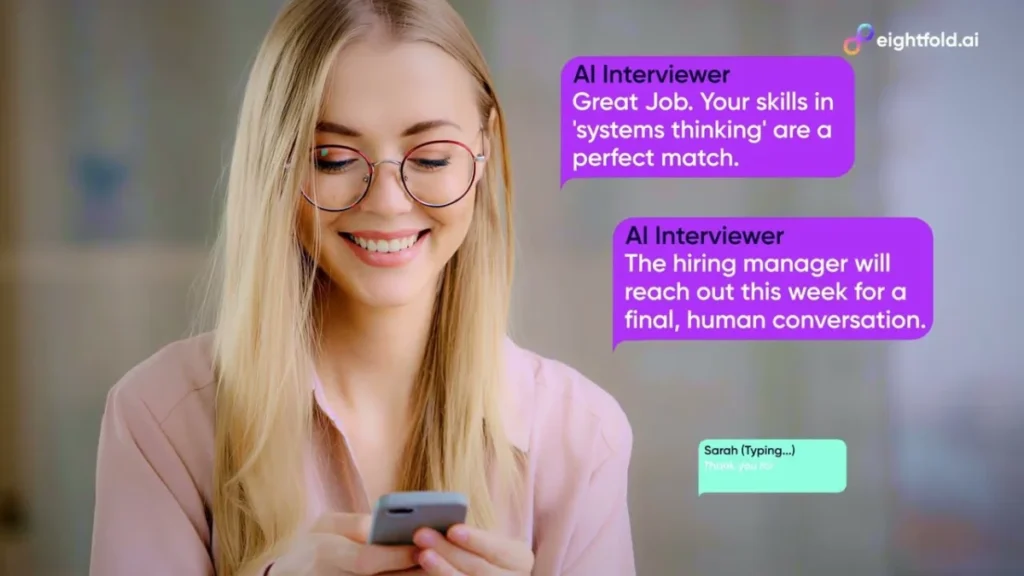
Eightfold AI’s AI Interviewer, for instance, operates as a fully autonomous system, capable of conducting interviews 24 hours a day, across multiple languages. This allows candidates to engage in the interview process immediately upon applying, eliminating scheduling delays and the need for recruiter intervention at this initial stage. Thousands of candidates can simultaneously navigate a structured and consistent screening process, significantly accelerating the initial stages of talent acquisition.
These AI systems are designed to perform specific types of evaluations, such as STAR-based functional interviews, coding assessments with real-time reasoning checks, and language proficiency evaluations. These capabilities are often grounded in extensive data sets and sophisticated talent intelligence engines, which analyze billions of real-world career trajectories to inform assessment criteria. This data-driven approach ensures that evaluations are aligned with actual job requirements and industry benchmarks.
The true strategic advantage of AI interviewing is the liberation of human interviewer time. Senior contributors, hiring managers, and functional leaders can then redirect their valuable expertise to the stages of the hiring process that truly demand their judgment and experience. This includes final-round interviews, in-depth culture and leadership assessments, and high-stakes evaluations where nuanced understanding and interpersonal connection are paramount. In essence, AI handles the volume and initial screening, allowing humans to focus on depth and strategic decision-making.
Crucially, AI interviewing solutions are increasingly being designed with fairness and compliance at their core. Evaluations are based on the content of candidates’ responses—their experiences, skills, and demonstrated capabilities—rather than subjective factors such as facial expressions, tone of voice, or other biometric signals. This content-based assessment approach not only promotes greater fairness but also ensures compliance with emerging regulations, such as New York City’s Local Law 144 and Illinois’ BIPA, which govern the use of automated employment decision tools. By generating consistent, data-driven insights, these AI systems provide hiring decision-makers with more reliable information upon which to base their selections.
Transformative Business Outcomes
The strategic deployment of AI interviewing as a capacity multiplier yields measurable business outcomes. Companies leveraging these solutions often report significant reductions in time-to-fill, with roles being filled weeks or even months faster than before. This accelerated hiring process directly translates into increased productivity and faster realization of business objectives.
Furthermore, the enhanced efficiency and consistency of AI-driven initial screenings can lead to a reduction in cost-per-hire. By streamlining the early stages, organizations can allocate recruiting resources more effectively and minimize the expenditure associated with prolonged vacancy periods. The ability to assess a larger pool of candidates more efficiently also means that organizations are less likely to miss out on top talent due to process delays, thereby improving the quality of hires and reducing the long-term costs associated with turnover and underperformance.
The strategic positioning of a company is also bolstered by its ability to hire rapidly and effectively. In a competitive market, speed and agility in talent acquisition can be a significant differentiator. Organizations that can quickly bring in the talent needed to drive innovation and seize opportunities gain a distinct competitive advantage. Moreover, by demonstrating a commitment to efficient and fair hiring practices, companies can enhance their employer brand, attracting a broader and more diverse pool of qualified candidates.
Addressing the Interviewer Shortage: A Strategic Imperative
The interviewer shortage is not merely a scheduling inconvenience; it is a structural capacity constraint that fundamentally limits an organization’s ability to hire, grow, and compete effectively. As hiring volumes continue to rise and the expectations of top candidates evolve, this challenge is likely to intensify.
Treating interviewer capacity as the strategic risk it truly is requires a paradigm shift. Organizations must move beyond incremental fixes and invest in building a scalable infrastructure for interviewing. This infrastructure should aim to extend human capability rather than simply taxing it further.
AI Interviewer represents such an infrastructure. It does not seek to replace the critical human conversations that define the later stages of the hiring process. Instead, it ensures that these essential conversations can occur more rapidly, more equitably, and without overburdening the very individuals upon whom the organization depends. By providing a robust and efficient platform for initial candidate assessment, AI Interviewer empowers organizations to navigate the complexities of modern talent acquisition with greater speed, fairness, and strategic foresight.
For organizations ready to confront and overcome the interviewer capacity crisis, exploring solutions like AI Interviewer is no longer optional; it is a strategic imperative. Engaging with teams that offer demonstrations, case studies, and tailored executive briefings can provide a clear path toward building a more resilient and effective talent acquisition function, one that is prepared to meet the demands of today’s dynamic business environment and secure the talent needed for future success.







